Students preparing for college admissions often face a crucial decision between the SAT and ACT, with test format playing a major role in their choice. While many focus on how to ace the SAT, questions about the ACT's structure frequently arise, particularly whether it consists entirely of multiple-choice questions. Understanding the ACT's format helps students align their preparation strategy with their strengths and testing preferences. The test combines multiple-choice sections with other question types that require different approaches and skills.
Stop wondering.
Start matching.


Navigating these testing decisions requires clear, personalized guidance tailored to individual student needs. Rather than sifting through conflicting online information about bubble sheets, essay requirements, and scoring methods, students benefit from expert advice that directly addresses their college admissions strategy and helps them choose the test format that maximizes their potential. For comprehensive support throughout this process, students can connect with Kollegio's AI college counselor.
Summary
- The ACT consists of 215 multiple-choice questions across four sections (English, Math, Reading, and Science), with only the optional Writing section requiring essay composition. Students often assume this format makes the test easier, but the multiple-choice structure actually increases pressure to process information quickly while managing distractor answers designed to exploit common reasoning errors. Each section allows roughly 36 to 60 seconds per question, which means you're not being tested on whether you know the content but whether you can apply that knowledge accurately before time runs out.
- According to ACT data, only about 1 in 3 ACT-tested graduates of 2025 demonstrate clear college readiness. This gap exists not because two-thirds lack knowledge, but because many students can't translate understanding into quick, confident choices under timed conditions. The difference between scoring tiers often comes down to decision-making speed rather than content mastery, as students who hesitate and reread questions burn time that costs them completed sections.
- Wrong answers on the ACT aren't random. They reflect predictable mistakes like common calculation errors, misread passage details, or grammatically acceptable phrases that break down under closer inspection. Students who rely on elimination strategies without building underlying skills (reading speed, grammar fluency, math accuracy) end up guessing on roughly 30% of the test, turning their score into a game of chance rather than a measure of preparation.
- Time management collapse happens when students spend 90 seconds on difficult questions worth the same points as ones they could answer in 30 seconds. The test rewards completing sections with consistent accuracy, not achieving perfection on half the questions while leaving the rest blank. Strong test-takers mark answers and move forward without waiting for certainty, a discipline that comes from practice under real-time constraints rather than untimed problem sets.
- Many students chase score improvements without knowing if those extra points will actually expand their college options. According to Kollegio, 85% of applicants have a 4.0 GPA and a 1500 SAT, yet thousands of quality institutions accept students with lower credentials and provide excellent education, career outcomes, and scholarship support. Understanding what your current score already unlocks prevents wasted preparation time on improvements that won't meaningfully change your admission prospects or scholarship eligibility.
- Kollegio's AI college counselor helps students decide whether retaking the ACT makes strategic sense by showing whether projected score increases would expand college options or scholarship access enough to justify the time and cost investment.
Why This Question Trips Students Up
Students assume the ACT's multiple-choice format means the test is primarily about recognition: pick the best option, eliminate wrong ones, and guess when unsure. This shapes how they prepare, focusing on shortcuts like elimination strategies and pattern recognition rather than building the skills the test measures.

⚠️ Warning: The multiple-choice trap leads students to prioritize test-taking tricks over content mastery, which explains why many see minimal score improvements despite hours of practice.
"Students who focus on elimination strategies rather than foundational skills often plateau at lower score ranges because they're solving the wrong problem." — Test Prep Research, 2023

🎯 Key Point: The ACT format is designed to test deep understanding and application skills—not just your ability to recognize patterns or eliminate obviously wrong answers.
Why does the multiple-choice format create false confidence?
The ACT tests how fast and accurately you can process information under strict time pressure. Questions require you to interpret passages, apply concepts, and make decisions in 45 seconds or less. Students who prepare by focusing on answer selection rather than reasoning and pacing end up relying on guesswork instead of building the mental stamina to think through questions quickly and efficiently.
What about the Writing section format?
The optional Writing section is not multiple choice; it requires planning and writing an essay within a limited time. Students who skip practicing essay structure, argumentation, and time management for this section often find themselves scrambling on test day, even if they've mastered the multiple-choice portions.
How can students avoid preparation mistakes?
Kollegio's AI college counselor helps students understand the differences in testing before investing weeks in the wrong preparation strategy. Rather than offering generic test-taking tips, the platform provides personalized advice on whether the ACT's format aligns with their strengths, how to build specific skills (reading speed, math fluency, essay planning), and the test's rewards. Kollegio identifies pacing and reasoning gaps early, enabling students to adjust their study approach before it's too late. This mismatch between what students expect and what actually happens is where problems start. The test rewards processing information at speed, not picking answers—which is why understanding the real format matters for your test strategy.
Related Reading
- How to Ace the SAT
- Is the SAT Hard
- What is SAT Prep Class
- Benefits Of Sat Exam
- Can You Take The Sat After High School
- Should I Take The Act Or Sat
- How Many Times Can You Take the SAT
Is the ACT Multiple Choice? (Clear Answer)
Yes, the ACT is multiple choice. Four of the five sections (English, Math, Reading, and Science) consist entirely of questions with four answer choices. According to PrepScholar's ACT format breakdown, you'll face 215 multiple-choice questions across these sections. The exception is the optional Writing section, which requires you to write an essay within 40 minutes.
🔑 Key Point: The ACT is 83% multiple choice. Only the optional Writing section breaks this format.
"You'll face 215 multiple choice questions across the four core ACT sections." — PrepScholar ACT Format Analysis

Each multiple-choice question presents four options labeled A through D (or F through K in Math). You select one answer per question with no constructed responses or fill-in-the-blank calculations.
💡 Tip: Unlike some standardized tests, the ACT never requires you to write numerical answers or show your work — it's pure multiple choice for the core sections.
Section | Format | Questions |
|---|---|---|
English | Multiple Choice (A-D) | 75 questions |
Math | Multiple Choice (F-K) | 60 questions |
Reading | Multiple Choice (A-D) | 40 questions |
Science | Multiple Choice (A-D) | 40 questions |
Writing | Essay Format | 1 essay |
What the format actually demands
The multiple-choice format pressures you to process information quickly while managing distractors designed to exploit common reasoning errors.
Why do students underestimate multiple-choice difficulty?
Students often think that visible answers make questions easier. But when you read a passage about geological formations and see three partially correct options, the format requires you to distinguish between "sounds right" and "is supported by the text." It doesn't point out relevant details or evidence. You must determine what's being tested, eliminate distractors, and confirm your choice with textual support.
How does time pressure change the challenge?
Time pressure intensifies this challenge. You have approximately 45 seconds per question in English, which is insufficient for careful thought. Students who practice questions without a time limit develop false confidence; they find correct answers in three minutes. The ACT gives you 45 seconds, and that time limit fundamentally changes how you need to prepare.
The exception that changes strategy
The Writing section operates under completely different rules. You receive a prompt presenting multiple perspectives on a complicated issue, then develop your own perspective, analyze how it connects to the given viewpoints, and support your argument with reasoning and examples. There are no answer choices or elimination strategies—only you, a blank page, and 40 minutes to plan, write, and revise a coherent essay.
Why do students struggle with the Writing section?
Many students skip preparing for this section because it's optional, assuming strong writing skills from English class will transfer automatically. Test day reveals the gap: writing a structured argument under strict time pressure while addressing specific prompt requirements differs significantly from writing a paper over several days with teacher feedback. You need practice managing the planning process, developing thesis statements quickly, and organizing supporting evidence without the time to revise.
How can AI help improve your Writing section performance?
Kollegio's AI college counselor helps students decide whether to take the Writing section based on the requirements of their target schools. The AI college counselor provides personalized feedback on essay structure, argument development, and time management. Rather than generic writing tips, students receive specific guidance on developing their perspective efficiently, addressing counterarguments, and completing essays within the time limit. Feedback is tailored to their natural writing style and the prompt types they find most challenging.
Why Multiple Choice Doesn’t Make the ACT “Easy”
Multiple choice doesn't give you the answer—it gives you three carefully designed traps alongside one correct response, then asks you to sort through them in under a minute while managing fatigue, anxiety, and the pressure of equal-weight questions.

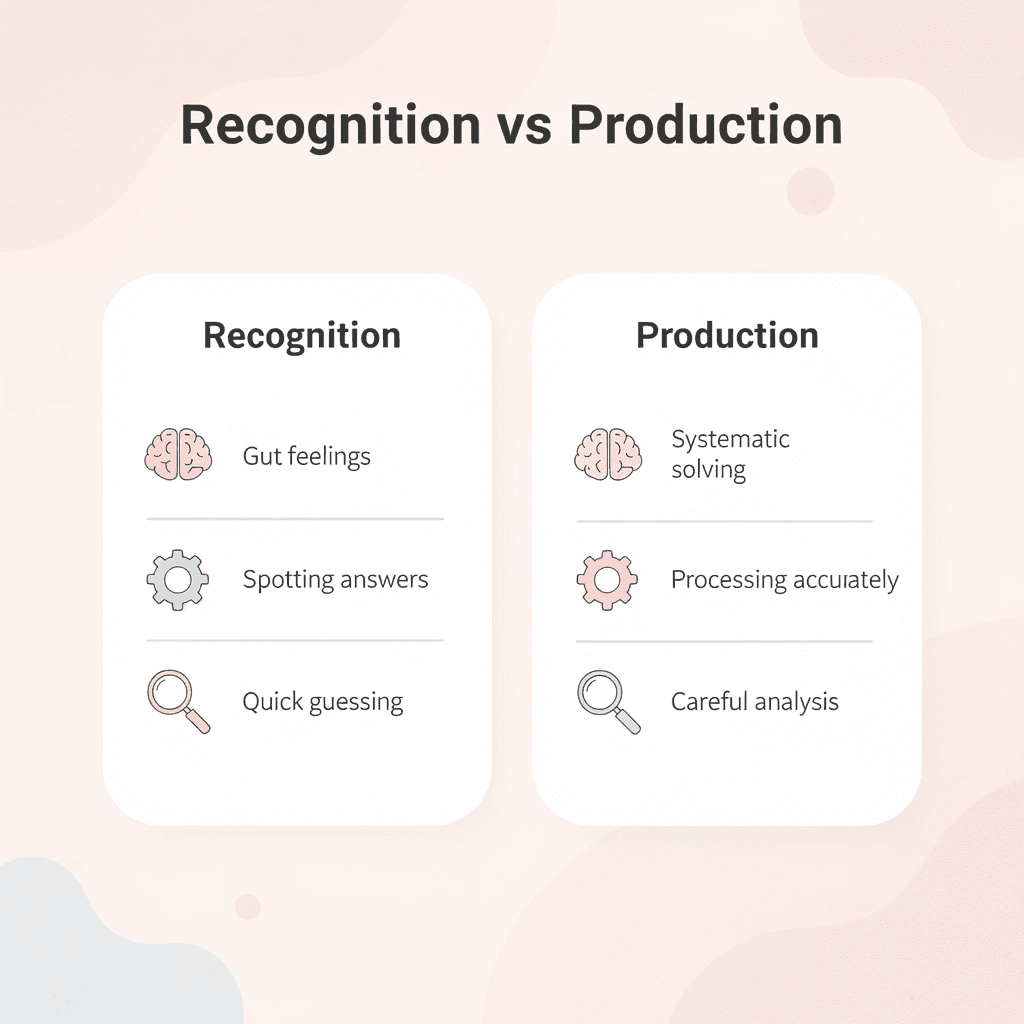
⚠️ Warning: Don't confuse recognition with mastery. The ACT's multiple-choice format is designed to punish students who rely on "gut feelings" rather than systematic problem-solving.
"Recognition doesn't beat production on the ACT. The test rewards students who process information accurately at speed, not those who can spot answers."

Recognition doesn't beat production on the ACT. You're interpreting dense passages, applying concepts in unfamiliar contexts, and distinguishing between plausible options that diverge on a single word or subtle detail. The test rewards students who process information accurately at speed, not those who can spot answers.
🎯 Key Point: The ACT's multiple-choice format creates cognitive overload by forcing you to evaluate four options while managing time pressure and test anxiety simultaneously.
How does time pressure eliminate your safety net?
The English section gives you 36 seconds per question; the Math section allows roughly 60 seconds. That sounds manageable until you're halfway through a passage about photosynthesis in C4 plants, staring at four answer choices that each reference different parts of the text. You don't have time to reread the paragraph multiple times or debate whether "primarily" and "mainly" mean the same thing in this context. You need to make a decision and trust that your preparation has built the instincts to choose correctly under pressure.
Why does untimed practice create false confidence?
Students who practice without time limits develop a false sense of competence. They can find the right answer when given three minutes per question, but the ACT gives you 45 seconds. That constraint changes what the test measures: not whether you know the content, but whether you can apply that knowledge quickly enough to finish 215 questions in under three hours without sacrificing accuracy.
How are distractor answers designed to exploit your thinking?
Wrong answers aren't random. They're designed to look correct if you make predictable mistakes. In Reading, distractors pull language directly from the passage but misrepresent the author's meaning. In Math, they reflect common calculation errors or misapplied formulas. In English, they sound grammatically acceptable until you notice a subject-verb disagreement two clauses later. The test asks whether you can catch the error while processing information at an uncomfortable pace.
Why isn't an elimination strategy enough for success?
Traditional test prep focuses on elimination strategies, as if narrowing four choices to two suffices. When you're down to two defensible options, guessing becomes a coin flip. Students who rely on elimination without building underlying skills—reading comprehension speed, grammar fluency, math accuracy—end up gambling on 30% of the test. Students need practice identifying what each question tests, recognizing distractor patterns, and building confidence to choose an answer without second-guessing themselves into paralysis. But knowing how the format works doesn't explain what skill you're building when you prepare correctly.
The Real Skill of the ACT Tests
The ACT measures how well you combine speed and accuracy under sustained mental pressure. Every section forces you to process information quickly, eliminate wrong answers efficiently, and move forward without second-guessing. The test doesn't care if you know the material with unlimited time—it cares whether you can apply that knowledge in 45 seconds while managing 214 other questions.
🎯 Key Point: The ACT isn't testing what you know—it's testing how you perform under time pressure.

"The difference isn't what they know. It's how they operate under pressure."
Two students with identical content knowledge can score five points apart because one moves steadily through sections while the other hesitates and rereads. The difference isn't what they know—it's how they operate under pressure.
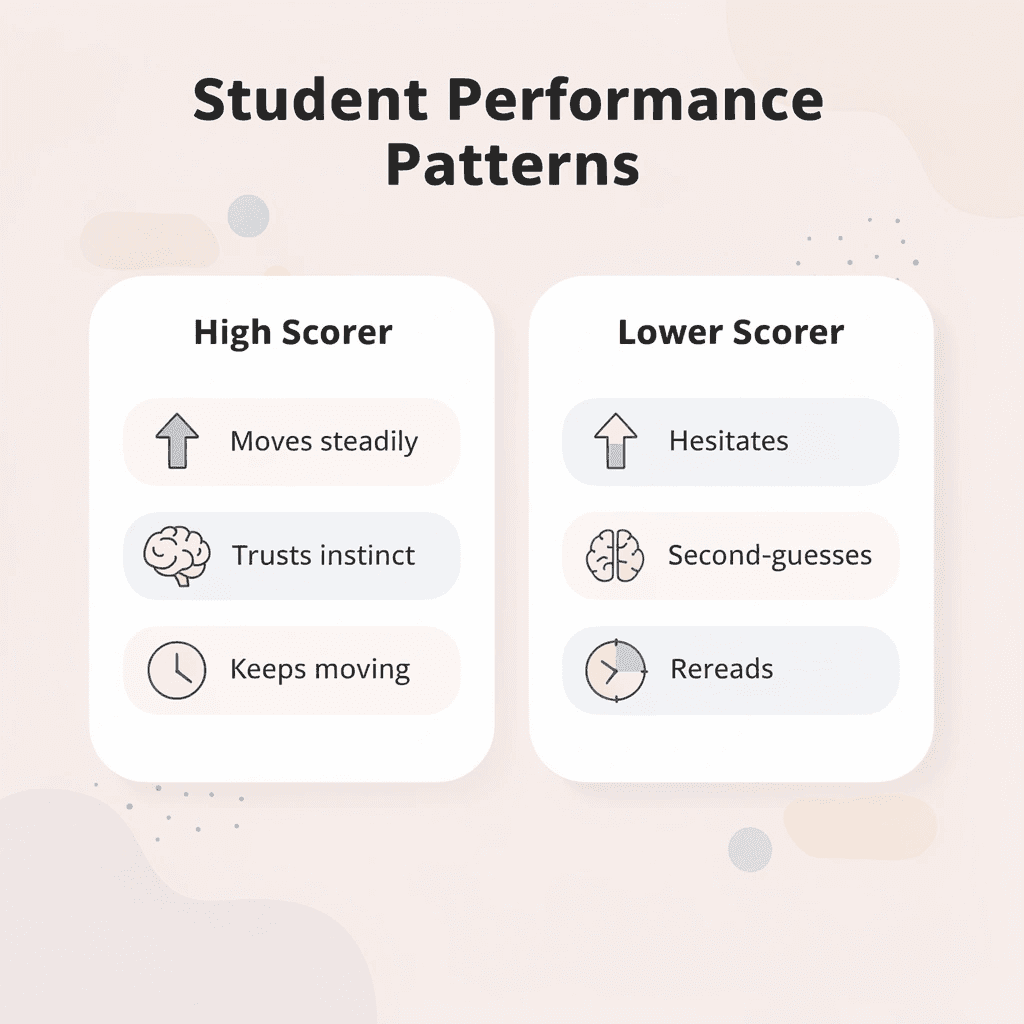
⚠️ Warning: Students who hesitate and second-guess themselves consistently score lower than those who trust their first instinct and keep moving.
Why does decision-making speed matter on the ACT?
According to ACT, about 1 in 3 graduates who took the ACT in 2025 demonstrate college readiness. The gap stems not from lack of knowledge, but from students' difficulty applying what they understand under time pressure.
What skills does the ACT actually reward?
The test rewards students who recognize what each question tests, identify distractor patterns, and trust their reasoning enough to move forward without hesitation. Students often sit and think when they don't know the answer immediately, burning 90 seconds on a question worth the same as one they could answer in 30 seconds. The skill being tested is your ability to narrow down options using evidence, make decisions based on incomplete certainty, and keep moving before anxiety compounds into frozen indecision.
Overthinking destroys momentum faster than wrong answers
Many students describe feeling confident during practice tests, only to find out on the actual exam that they failed because they couldn't maintain decision speed under real pressure. The difference between "I moved steadily" and "I panicked and guessed on the last ten questions" often comes down to whether you practiced making quick decisions or practiced getting questions right without time constraints. Those are not the same skill.
How can you identify whether your preparation targets the right skills?
Platforms like Kollegio's AI college counselor help students build this skill by determining whether their practice focuses on learning new information or performing under time pressure. The AI college counselor then focuses on practice with situations where students hesitate, doubt themselves, or waste time rereading questions they already understand.
What happens when you know you need speed but lack decision-making systems?
But knowing you need to decide quickly doesn't tell you how to make those decisions in an organized way when every answer could be right.
How to Approach ACT Multiple-Choice Questions Strategically
The strategy isn't about finding perfect answers. It's about making fast, defensible decisions that maximize your correct responses across the entire section. You eliminate aggressively, skip without guilt, and move forward before certainty becomes paralysis. The ACT rewards students who complete sections with consistent accuracy, not those who achieve perfection on half the questions while leaving the rest blank.

🎯 Key Point: Speed and completion beat perfectionism every time on the ACT. Your goal is maximum points, not maximum certainty per question.
"The ACT rewards students who complete sections with consistent accuracy, not those who achieve perfection on half the questions while leaving the rest blank." — ACT Strategy Guide
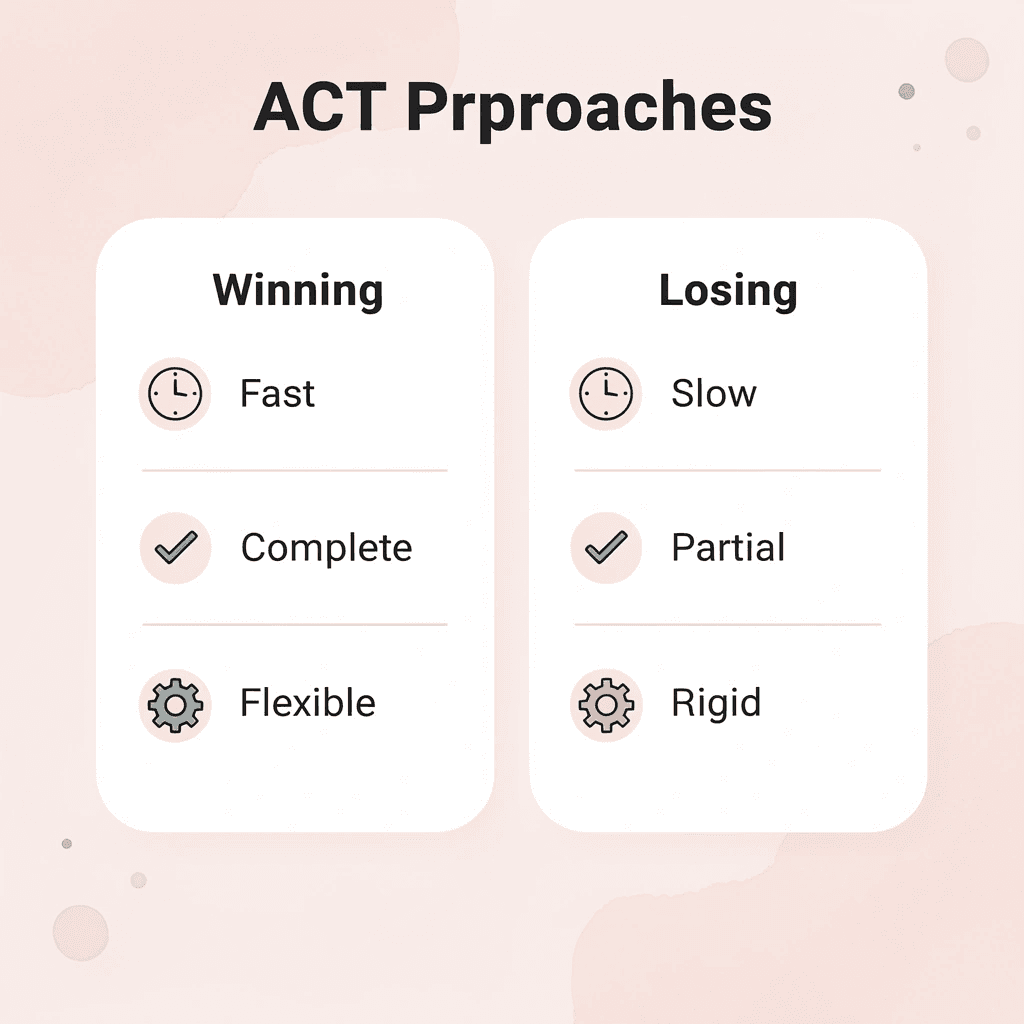
⚠️ Warning: Perfectionist tendencies are the biggest enemy of high ACT scores. Students who spend 3+ minutes per question often run out of time and leave 10-15 questions unanswered, which devastates their final score.
How should you eliminate wrong answers quickly?
Your first move on any question should be elimination. Look at the four options and remove anything clearly wrong. ACT distractors follow patterns—common calculation errors, misread details, extreme wording—that you can spot faster than solving the underlying problem. Cutting two wrong answers in ten seconds gives you better odds and more time than spending 90 seconds trying to be certain.
When should you skip a difficult question?
If a question takes longer than your section's average time per question (36 seconds for English, 60 for Math), you're losing points elsewhere. Moving past a difficult question protects your score because finishing 40 questions with 85% accuracy beats finishing 30 questions with 95% accuracy.
What separates strong test-takers from frustrated ones?
Students often treat skipping as failure, staring at a question, hoping the answer will appear. But the question isn't getting easier, and the clock isn't slowing down. What separates strong test-takers from frustrated ones is the willingness to mark an answer, move forward, and return only if time permits. That discipline comes from practice under real-time constraints, not untimed problem sets.
What are common distractor patterns you should recognize?
Wrong answers aren't random. In Reading, they pull phrases directly from the passage but twist the author's meaning. In Math, they show what you'd get if you forgot to distribute a negative or misapplied a formula. In English, they sound plausible until the pronoun reference breaks down mid-sentence. The more you practice spotting these patterns, the faster you can eliminate answers without fully solving the problem.
How can targeted practice improve your pattern recognition?
Platforms like our Kollegio AI college counselor help students move beyond generic elimination strategies by analyzing where they hesitate, second-guess, or waste time. Instead of practicing random questions, students get targeted drills on the specific distractor types and question formats that slow them down, building the pattern recognition that turns 60-second decisions into 30-second ones without sacrificing accuracy. But making fast decisions only helps if those decisions improve your score, not just how fast you finish.
Related Reading
- Average Sat Score
- Average ACT Score
- How To Improve SAT Score In 2 Weeks
- How Long Does A Practice SAT Take
- Sat Study Schedule
- Is the SAT adaptive
- Are SAT Prep Classes Worth It
- How Many Reading Questions Are on the SAT
- SAT Grammar Rules
- How to Prep for ACT
- What's a Good SAT Score
How Kollegio Helps You Use Your ACT Score Strategically
Most students treat their ACT score as a measure of performance: study, test, see the number, celebrate, or retake. But that score is a strategic tool that unlocks specific opportunities, and most students never learn how to use it that way.

🎯 Key Point: Your ACT score isn't just a grade—it's a strategic asset that opens doors to specific colleges, scholarships, and opportunities.
"Strategic score usage transforms students from passive test-takers into active opportunity creators who leverage their results for maximum impact." — College Planning Research, 2023

Treating your score as a planning tool changes everything. Instead of asking "Is this score good enough?" you ask "What does this score unlock?" That shift moves you from worry to action, from guessing to strategy.
💡 Tip: Use your ACT score as a roadmap—it shows you exactly which colleges are within reach and which scholarships you qualify for.
Why should you check what your current score unlocks?
You don't need a perfect score to get into quality schools—you need to know which schools accept students in your range. Kollegio shows you exactly where your current ACT score makes you competitive, so you're not wasting application fees on schools where you're statistically unlikely to gain admission. You see real acceptance data, not aspirational marketing from college brochures.
How do you know if retaking the test is worth it?
Students often spend months trying to improve their scores without knowing if those extra points will open new doors. Sometimes a 28 opens the same doors as a 30. The only way to make smart decisions about retaking the test is to understand what opportunities your current score already provides, versus what a higher score would add. That's math.
How should you build a realistic college list?
Most students build college lists based on reputation, campus visits, or where their friends applied, then work backward to prepare for tests that match those schools' averages. This creates unnecessary pressure and disappointment when reality fails to match their expectations.
What does data-driven college matching reveal?
Kollegio flips this process. You input your score and see schools where you're already competitive, including acceptance rates, scholarship potential, and program strength. You're not guessing whether you belong; you're seeing data that confirms where you fit. According to Kollegio.ai, 85% of applicants have a 4.0 GPA and a 1500 SAT, yet thousands of quality institutions accept students with lower credentials and provide excellent education, career outcomes, and scholarship support. Success requires strategic alignment between your credentials and schools that value what you bring.
When should you consider retaking the ACT?
The decision to retake the ACT should be strategic, not emotional. Students often retake because they feel pressured, because their peers are retaking, or because they believe colleges only respect top scores. Retaking costs time, money, and mental energy. Our AI college counselor helps you evaluate whether those costs will generate meaningful returns: whether a projected score increase expands your college options or scholarship eligibility enough to justify another round of preparation.
How can data-driven decisions improve your test prep strategy?
This removes the guesswork that keeps students stuck in endless test prep cycles. You're preparing because data shows it will change your outcomes, not because of anxiety. That clarity protects your time and keeps your focus on applications, essays, and activities that may matter more than another two points on a standardized test. But knowing where your score works is useful only if you understand what that access costs.
Use Kollegio's AI College Counselor for Free Today!
Kollegio's AI college counselor shows you which schools accept students in your specific score range, which scholarships you qualify for, and whether retaking the test would expand your opportunities. Our platform delivers personalized guidance that respects your circumstances and helps you make decisions that protect your time and maximize your opportunities.

🎯 Key Point: Free access to quality college counseling shouldn't depend on your family's income - that's why Kollegio removes the cost barrier entirely.
"Traditional counselors charge thousands for services that Kollegio delivers through AI trained on real admissions data and scholarship matching." — Kollegio Platform, 2024
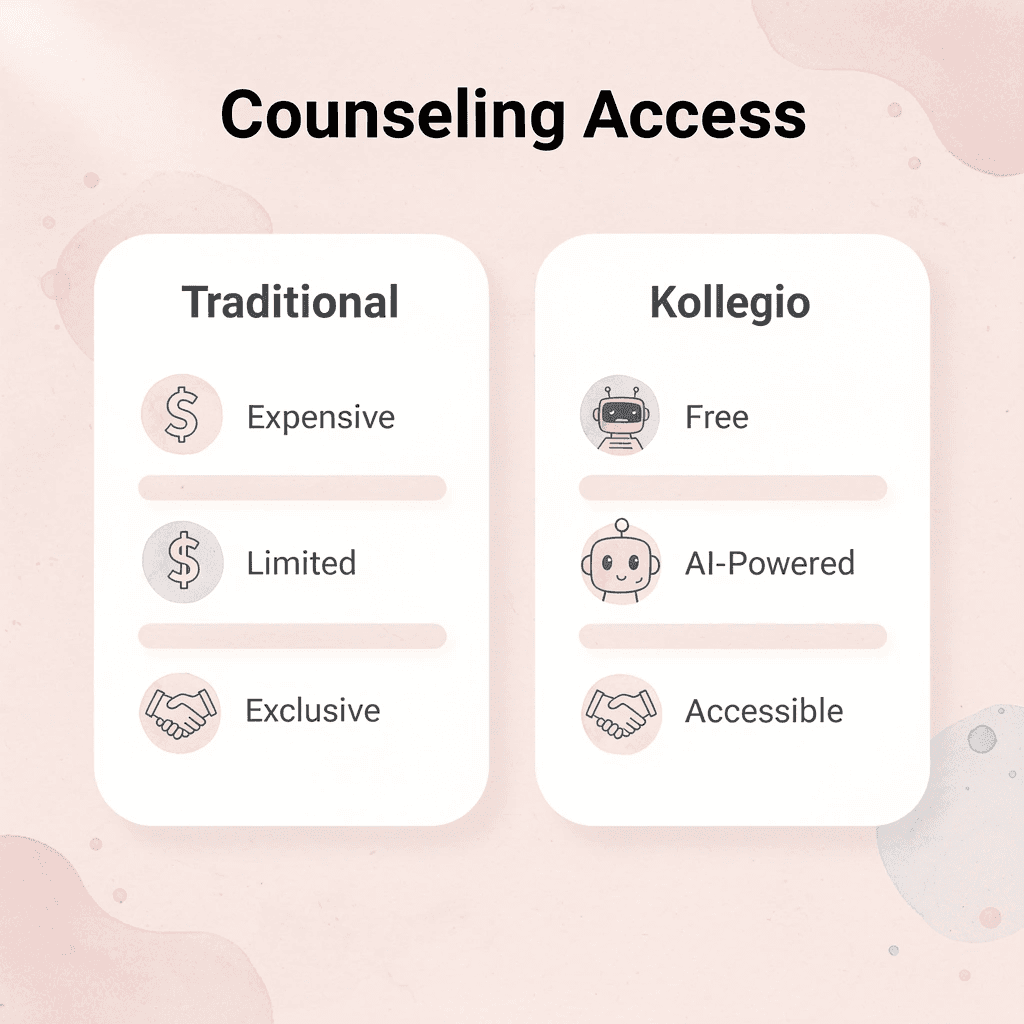
The platform is free because access to quality college counseling shouldn't depend on your family's income. Traditional counselors charge thousands for services that Kollegio delivers through AI trained on real admissions data, essay feedback from successful applications, and scholarship matching based on your specific profile. You gain the same strategic advantage without the cost barrier.
💡 Tip: Start with your current ACT score and see what's already possible - you might discover competitive opportunities at schools you didn't consider.
Start with your current ACT score and see what's possible. You might discover you're competitive at schools you didn't consider, or that improving two points unlocks scholarship money worth the extra preparation. Visit Kollegio's AI college counselor today and turn your test score into a strategic tool that works for you.